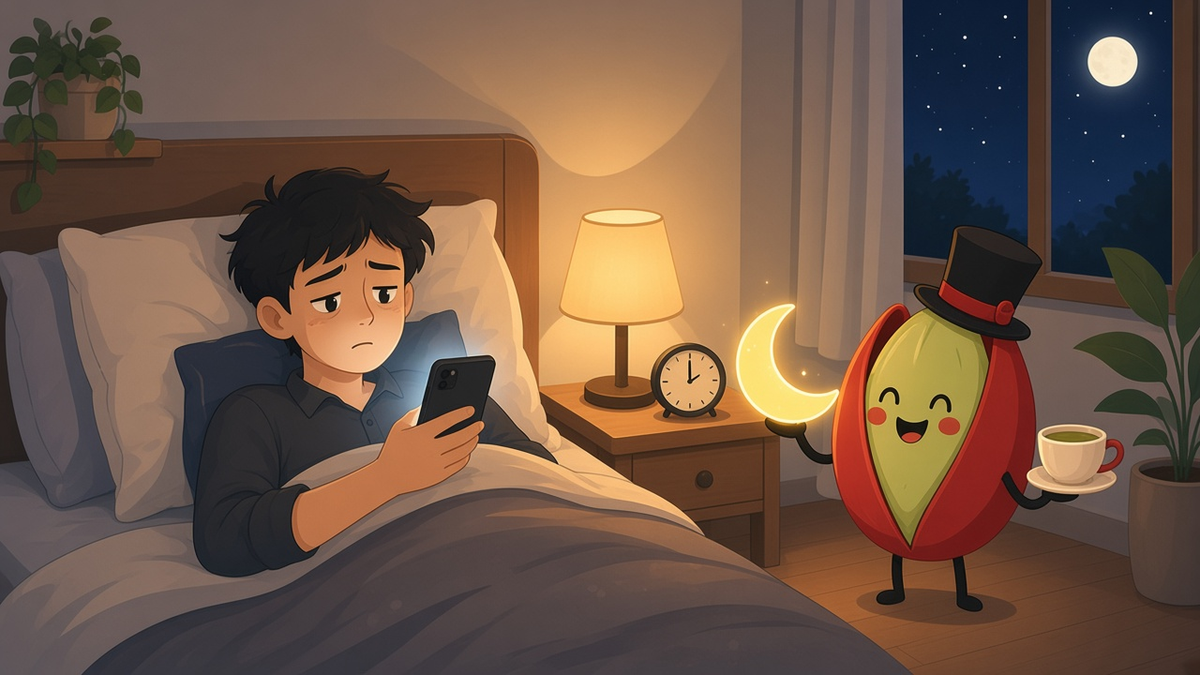
It’s 11:58 p.m. You have a 9 a.m. meeting. You are exhausted. And you are watching a 40-minute video about how they restore old canoes.
You know you should be asleep. You want to be asleep. But a small, stubborn voice says, “This is the first time all day that nobody needs anything from me.” So you keep going.
That voice has a name: revenge bedtime procrastination. If you work long days at a screen, there’s a good chance you’ve met it. Let’s look at why it happens and how to get your nights back without giving up the “me time” you’re fighting for.
What Is Revenge Bedtime Procrastination?
Researchers at Utrecht University introduced the idea of bedtime procrastination in a 2014 study. They defined it as failing to go to bed at the intended time while no outside circumstances are stopping you (Kroese et al., Frontiers in Psychology, 2014). No crying baby, no night shift, no emergency. Just you, a phone, and one more episode.
The “revenge” part came later. According to the Sleep Foundation, the phrase spread on social media from a translation of a Chinese expression about long, stressful work hours that left little time for personal life (Sleep Foundation). The “revenge” is on the workday. If the job took your daylight, you’ll take the night.
It shows up in two flavors:
- The late lights-out: you simply don’t go to bed when you planned to.
- The pillow scroll: you get into bed on time, then spend an hour on your phone before you try to sleep.
Many of us are fluent in both.
Why Busy Workdays Trigger It
Here’s the part that makes this a knowledge-worker problem, not a character flaw.
1. You’re not avoiding sleep. You’re avoiding the end of your time.
Procrastination usually means putting off something unpleasant, like taxes. But bed is nice! The 2014 study’s authors suggested that bedtime procrastination may be less about not wanting to sleep and more about not wanting to quit whatever you’re doing. Going to bed means the day is officially over, and your free part of it was about 45 minutes long.
2. Your willpower is running on fumes
The same researchers pointed out that the decision to go to bed happens at the end of the day, when self-control is typically at its weakest. After eight hours of meetings, messages and judgment calls (plus, for many of us, checking AI output all day, which we covered in our piece on AI brain fry), “just put the phone down” is a big ask.
3. Screens make “one more” endless
The Sleep Foundation notes that using screens before bed can stimulate the brain and delay the natural wind-down your body needs. Streaming apps autoplay. Feeds never end. There’s no natural stopping point, so you have to make one.
What It Costs You
One late night won’t ruin you. The trouble starts when it becomes the default.
The CDC says adults ages 18 to 60 need 7 or more hours of sleep, and that enough sleep can help reduce stress, improve your mood, and sharpen attention and memory (CDC). That’s everything you need for tomorrow’s workday.
In the 2014 study, almost 30% of participants said they slept 6 hours or less on weeknights, and about 84% said they felt they had slept too little or felt tired during the day at least once a week. People who reported more bedtime procrastination also reported less sleep and more daytime tiredness. (It was a survey, so it shows a link, not proof of cause. Still, it’s a link most of us can feel in our eyelids.)
And there’s a loop: short sleep makes the next day harder, a harder day makes you crave more “revenge” time that night, and around you go.
How to Stop Revenge Bedtime Procrastination: 7 Ways
The goal is not to cancel your me time. It’s to stop stealing it from your sleep. Pick two of these and try them for a week.
1. Move your me time earlier
If the real hunger is for free time, feed it sooner. Block 20 to 30 minutes right after work, or right after dinner, that belongs only to you. A walk, a game, a book, a show. When you’ve already had some fun, midnight has less to offer.
2. Make a plan for the exact moment
The 2014 researchers suggested that strategies that don’t rely on willpower may work best here. One option they mentioned is an “if-then” plan, which psychologists call an implementation intention. Try something like: “When the episode ends, I plug my phone in across the room.” You make the decision at noon, when you have the energy, not at midnight, when you don’t.
3. Give your phone its own bedtime
The CDC recommends turning off electronic devices at least 30 minutes before bed. Set a recurring alarm called “Phone goes to bed,” then actually put it to bed: charger in the kitchen, the hallway, anywhere that isn’t arm’s reach from your pillow. A cheap alarm clock helps.
4. Kill the autoplay
Autoplay is the bottomless snack bowl of the internet. Turn it off in your streaming and video apps so every episode ends with a pause and a choice. A pause is often all you need to notice it’s late.
5. Build a wind-down you look forward to
Bedtime feels like the end of fun because we make it boring. Make it a small treat instead: a warm shower, a paper book, some gentle stretches, a cup of caffeine-free tea. The Sleep Foundation suggests a steady routine of relaxing activities like reading, meditation or light stretching, plus a dark, quiet, cool bedroom.
6. Keep the same wake-up time, even on weekends
The CDC lists going to bed and getting up at the same time every day as a healthy sleep habit. A steady wake-up time keeps your body clock from drifting, which makes it easier to feel sleepy at a sensible hour. Sleeping in until noon on Saturday is a great way to be wide awake at 1 a.m. on Sunday.
7. Fix the daytime, not just the night
Revenge bedtime procrastination is often a symptom of days with no breathing room. Protect a real lunch break. Take short breaks between meetings. Leave work at a set time when you can. The more of your day that feels like yours, the less you’ll need to steal back at night.
When It’s More Than a Bad Habit
If you go to bed on time and still can’t sleep, wake up a lot during the night, or feel exhausted even after plenty of rest, that may be something other than procrastination. The CDC recommends talking with a healthcare provider if you regularly have problems sleeping. A simple sleep diary (when you go to bed, wake up, nap, and have caffeine or alcohol) can make that conversation much more useful.
FAQ
Is revenge bedtime procrastination a medical diagnosis?
No. It’s a popular term for a real, common behavior: staying up later than you meant to, usually to get some personal time. Researchers study bedtime procrastination, but it isn’t a clinical condition on its own.
Is it a discipline problem?
Not really. Self-control tends to run low at the end of the day, especially after a draining workday. That’s why tricks that remove the decision (phone charging in another room, autoplay off) beat just trying harder.
What’s one thing I can do tonight?
Pick a time 30 minutes before your target bedtime, set an alarm for it, and when it goes off, put your phone on a charger outside your bedroom. That’s it.
The Pistachio Bottom Line
You deserve time for yourself. You also deserve sleep. The trick is making sure one doesn’t keep robbing the other. Take your me time earlier, give your phone a bedtime, and let tomorrow’s version of you wake up feeling like a well-roasted pistachio instead of a burnt one.
This article is for general education only and isn’t medical advice. If you have ongoing sleep problems, low mood, or daytime exhaustion, please talk with a doctor or other licensed healthcare professional.